CNC machines play a major role in modern manufacturing. Industries use them to produce accurate and complex parts.The most common comparison is between 3-axis and 5-axis CNC machines.
Understanding their differences helps students, operators, and manufacturers choose the right machine for their work.
What is a 3-Axis CNC Machine?
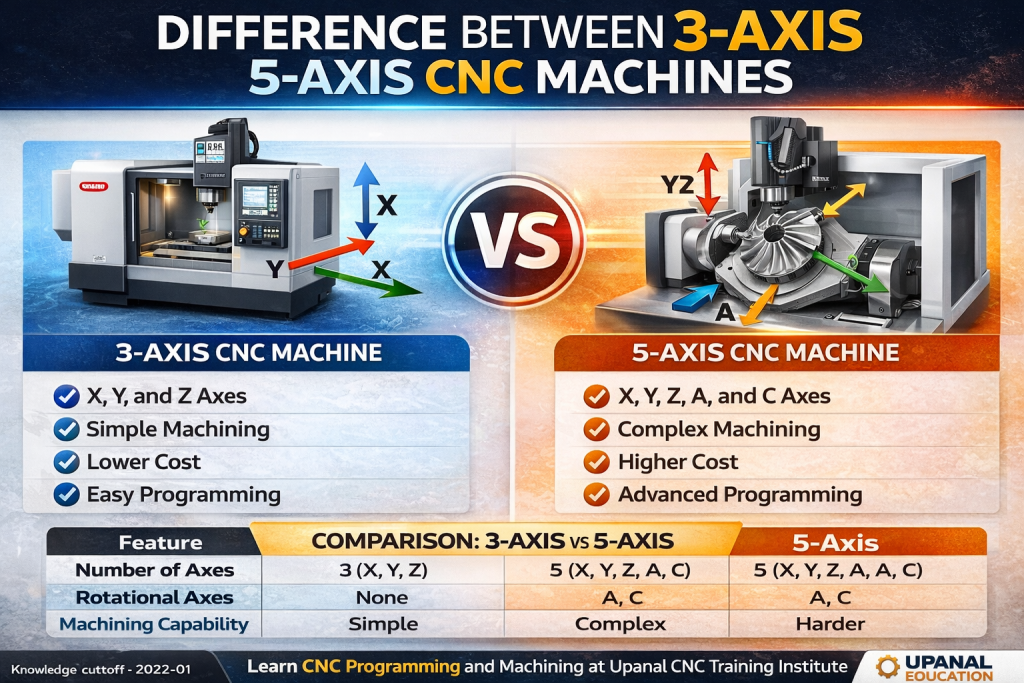
A 3-axis CNC machine moves the cutting tool in three directions:
- X-axis (Left to Right)
- Y-axis (Front to Back)
- Z-axis (Up and Down)
The tool remains in a fixed vertical position. The workpiece stays stationary while the tool moves along these three linear directions.
Key Features of 3-Axis CNC
Applications
Manufacturers use 3-axis machines for:
- Slot cutting
- Drilling
- Facing operations
- Simple pocket milling
Because of its simplicity, training institutes often start CNC learning with a 3-axis machine.
What is a 5-Axis CNC Machine?
A 5-axis CNC machine moves in five directions.
It also includes two rotational axes.
As a result, it improves surface finish.
It also reduces setup time.
Additional Movements
- A-axis (Rotation around X-axis)
- B-axis (Rotation around Y-axis)
This flexibility increases machining capability.
Key Features of 5-Axis CNC
- Advanced programming
- High precision
- Complex geometry machining
- Reduced setup time
- Better surface finish
Key Differences Between 3-Axis and 5-Axis CNC
1. Movement
3-axis machines move only in straight directions.
In contrast, 5-axis machines include rotational movement.
2. Complexity
3-axis machines handle simple parts.
On the other hand, 5-axis machines produce complex components.
3. Setup Time
Operators reposition parts multiple times in 3-axis machining.
However, 5-axis machines complete most jobs in one setup.
4. Cost
3-axis machines require lower investment.
Meanwhile, 5-axis machines demand higher capital and skilled programmers.
5. Accuracy
Because 5-axis machines reduce repositioning, they deliver better precision.
Conclusion
Both 3-axis and 5-axis CNC machines serve important roles in manufacturing. A 3-axis machine offers simplicity and affordability. On the other hand, a 5-axis machine provides flexibility and precision for advanced applications.
Before selecting a machine, analyze your project needs carefully. The right decision improves productivity, reduces errors, and increases profit.