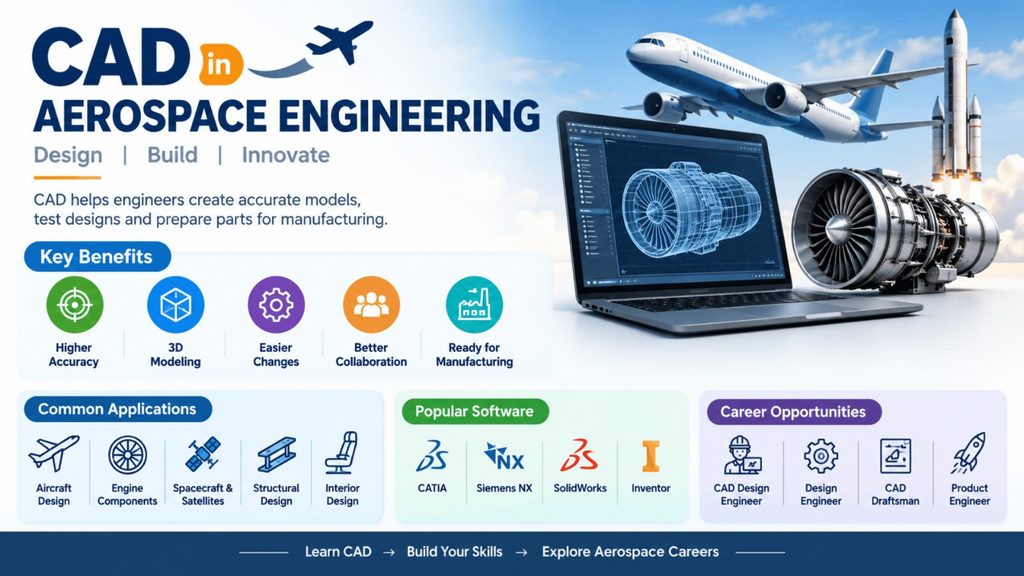
Computer-Aided Design (CAD) plays an important role in modern aerospace engineering. Engineers use CAD software to design aircraft, spacecraft, engines, and other aerospace components. It helps them create accurate 3D models, test designs, and prepare parts for manufacturing.
Today, aerospace companies rely on digital design tools to develop complex products. Therefore, learning CAD can help mechanical engineering students and aspiring designers explore opportunities in the aerospace industry.
What Is CAD in Aerospace Engineering?
CAD in aerospace engineering is the use of computer software to create, modify, and analyze aircraft and spacecraft designs.
Engineers use CAD software to develop detailed 2D drawings and 3D models. These models help them understand component shapes, dimensions, and assembly requirements.
Moreover, CAD allows engineers to make design changes quickly. As a result, they can improve designs before manufacturing begins.
Importance of CAD in Aerospace Engineering
Aerospace components require careful design and precise manufacturing. Even small dimensional errors can affect how a component fits or performs.
CAD helps engineers manage these challenges through accurate modeling and detailed engineering drawings.
Here are some important benefits:
- Improves design accuracy
- Supports complex 3D modeling
- Reduces manual drafting work
- Makes design changes easier
- Helps check component fit
- Supports collaboration between engineering teams
- Prepares designs for manufacturing
Therefore, CAD is an essential tool in many aerospace design workflows.
Applications of CAD in Aerospace Engineering
CAD software supports several stages of aircraft and spacecraft development. Here are some common applications.
1. Aircraft Design
Aerospace engineers use CAD to design aircraft structures, wings, fuselages, and other components.
They create detailed models to study component shapes and assembly requirements. Furthermore, these models help engineering teams communicate design changes.
2. Aerospace Engine Components
Aircraft engines contain many complex mechanical components. CAD helps engineers design parts such as turbine blades, compressor components, housings, and engine mounts.
Additionally, detailed models help engineers check how different parts fit together.
3. Spacecraft and Satellite Design
CAD is widely used to develop spacecraft structures, satellite frames, brackets, and equipment housings.
Engineers use 3D models to plan component placement and assembly. Consequently, CAD supports the development of complex space systems.
4. Aerospace Structural Design
Aircraft structures must meet strict design and engineering requirements. CAD helps engineers create models of structural components, joints, frames, and support systems.
Moreover, these models can support further engineering analysis and design verification.
5. Interior Component Design
CAD also supports the design of aircraft interiors. Engineers use it to develop seats, cabin panels, storage compartments, and mounting brackets.
As a result, design teams can check dimensions, component placement, and assembly details before production.
Popular CAD Software Used in Aerospace Engineering
Different aerospace companies use different software based on their design requirements and existing workflows.
| CAD Software | Common Applications |
| CATIA | Aircraft structures and complex surface design |
| Siemens NX | Aerospace product design and engineering |
| PTC Creo | 3D modelling and mechanical assemblies |
| SolidWorks | Mechanical components and product design |
| Autodesk Inventor | Mechanical modelling and assemblies |
Each software package offers different tools. Therefore, learners should select software based on their career goals and the requirements of their target industry.
How CAD Supports Aerospace Manufacturing
CAD connects product design with manufacturing. Once engineers complete a model, they can use the design data to plan production.
For example, CAD models can support:
- Engineering drawing preparation
- Component dimension checks
- Assembly planning
- CNC machining preparation
- Tool and fixture design
- Design updates
Furthermore, CAD models can be transferred into CAM software to develop CNC machining toolpaths.
This CAD-to-CAM workflow helps manufacturers prepare complex aerospace components for production. However, engineers must still verify machining programs, material requirements, and quality standards before manufacturing.
CAD, CAM, and CNC in Aerospace Engineering
CAD, CAM, and CNC work together in many aerospace manufacturing processes.
CAD Design
Create the 2D drawing or 3D component model.
CAM Programming
Generate toolpaths and prepare machining instructions.
CNC Machining
Machine the component using a verified CNC program.
Quality Inspection
Check dimensions and confirm the component meets its specifications.
This workflow connects digital design with physical manufacturing. Consequently, CAD knowledge can be useful for students interested in aerospace design as well as CNC machining.
Skills Required for Aerospace CAD Designers
Aerospace CAD designers need a combination of software knowledge and engineering fundamentals.
Important Technical Skills
- 2D drafting and 3D modeling
- Engineering drawing interpretation
- Geometric Dimensioning and Tolerancing (GD&T)
- Mechanical design fundamentals
- Surface and assembly modeling
- Material knowledge
- Basic manufacturing processes
- CAD data management
In addition, communication and problem-solving skills help designers work with engineers from different departments.
Career Opportunities in Aerospace CAD
CAD skills can support several career paths in aerospace and related engineering fields.
| Job Role | Main Responsibility |
| CAD Design Engineer | Creates engineering models and drawings |
| Aerospace Design Engineer | Develops aircraft or spacecraft components |
| Mechanical Design Engineer | Designs mechanical systems and parts |
| CAD Draftsman | Prepares technical drawings |
| Product Design Engineer | Develops and improves product designs |
| CAD/CAM Engineer | Connects digital designs with manufacturing processes |
Actual job requirements vary by employer. Some aerospace positions also require an engineering degree, industry experience, or specialized knowledge of aerospace standards.
How Students Can Start Learning CAD for Aerospace
Students from ITI, Diploma, and Mechanical Engineering backgrounds can begin by building strong CAD fundamentals.
Step 1: Learn Engineering Drawing
Start with dimensions, orthographic views, sections, and tolerances. These concepts help you understand technical drawings.
Step 2: Practice 3D Modeling
Learn how to create basic components using sketches, extrusions, revolutions, and other modeling tools.
Step 3: Build Mechanical Projects
Practice designing brackets, shafts, housings, and assemblies. These projects help develop modeling accuracy.
Step 4: Explore Advanced CAD Features
Move on to surface modeling, complex assemblies, and design validation tools as your skills improve.
Step 5: Understand Manufacturing
Learn how components are machined and assembled. This knowledge helps you create designs that are easier to manufacture.
Step 6: Create a Design Portfolio
Save your models, engineering drawings, and project descriptions. A portfolio can help demonstrate your practical skills to employers.
Future Scope of CAD in Aerospace Engineering
Aerospace engineering continues to use advanced digital design and manufacturing technologies. As a result, CAD remains an important part of product development.
Several technologies are shaping aerospace design:
- Generative design: Helps engineers explore different design options.
- Digital twins: Connect digital models with information about physical systems.
- Simulation tools: Support engineering analysis and design verification.
- Additive manufacturing: Enables the production of selected complex components.
- CAD/CAM integration: Connects digital designs with manufacturing processes.
Furthermore, these technologies increase the need for engineers who understand both design software and manufacturing principles.
Conclusion
CAD plays a vital role in aerospace engineering by helping engineers create accurate models, develop complex components, and prepare designs for manufacturing. It supports aircraft design, engine development, spacecraft structures, and many other applications.
Moreover, CAD knowledge provides a foundation for learning CAM software and CNC manufacturing. Students who develop strong modeling skills, understand engineering drawings, and gain practical project experience can explore career opportunities in aerospace and related industries.