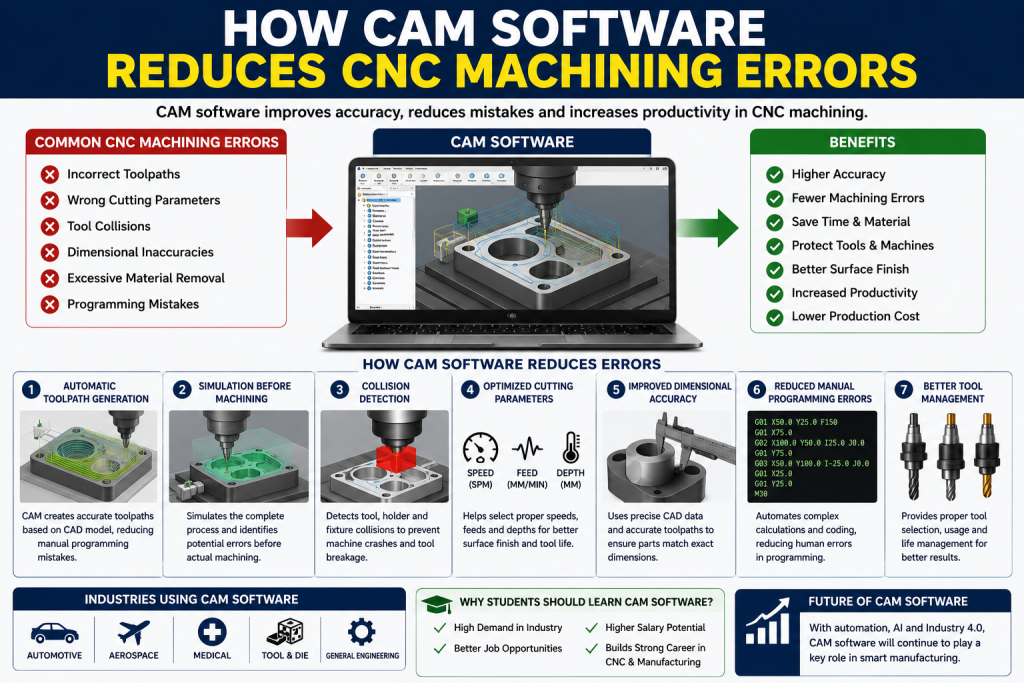
CAM Software CNC Errors are a major concern in manufacturing. However, CAM software helps reduce these errors and improves machining accuracy.
CAM (Computer-Aided Manufacturing) software helps programmers create accurate CNC programs. As a result, machining operations become faster, safer, and more reliable.
What is CAM Software?
CAM software converts CAD designs into CNC machine programs. It creates toolpaths and generates G-code automatically.
Therefore, programmers can prepare machining operations with greater accuracy. Moreover, CAM software helps reduce manual programming errors.
Common CNC Machining Errors
Before understanding the benefits of CAM software, it is important to know the common machining errors.
Common Errors Include:
- Incorrect toolpaths
- Wrong cutting parameters
- Tool collisions
- Dimensional inaccuracies
- Excessive material removal
- Programming mistakes
As a result, these errors can increase production costs and reduce product quality.
How CAM Software Reduces CNC Machining Errors
1. Automatic Toolpath Generation
CAM software creates toolpaths automatically based on the CAD model.
Therefore, programmers do not need to calculate every movement manually. As a result, the chances of programming mistakes decrease significantly.
Benefits
- Accurate tool movement
- Reduced human error
- Faster programming process
2. Simulation Before Machining
One of the biggest advantages of CAM software is simulation.
Before actual machining begins, operators can simulate the entire process. Consequently, they can identify problems before production starts.
Benefits
- Detects programming mistakes
- Prevents machine crashes
- Improves confidence before machining
3. Collision Detection
Tool collisions can damage machines, tools, and workpieces.
However, CAM software detects possible collisions during simulation. Therefore, programmers can correct problems early.
Benefits
- Protects machine components
- Prevents tool breakage
- Reduces maintenance costs
4. Optimized Cutting Parameters
CAM software helps select suitable cutting speeds and feed rates.
As a result, machining becomes more efficient and accurate. Moreover, proper parameters improve tool life.
Benefits
- Better surface finish
- Improved tool performance
- Consistent machining quality
5. Improved Dimensional Accuracy
CAM software uses precise CAD data to generate toolpaths.
Therefore, finished components closely match design specifications. In addition, dimensional errors are minimized.
Benefits
- Higher product quality
- Better accuracy
- Reduced rework
6. Reduced Manual Programming Errors
Manual CNC programming requires careful calculations.
However, CAM software automates many programming tasks. Consequently, programmers spend less time correcting mistakes.
Benefits
- Faster program creation
- Fewer coding errors
- Increased productivity
7. Better Tool Management
CAM software provides detailed information about tools and machining operations.
As a result, operators can select the correct tools for each job. Furthermore, proper tool selection improves machining performance.
Benefits
- Correct tool usage
- Reduced tool wear
- Better machining results
Industries Using CAM Software
Many industries rely on CAM software for accurate manufacturing.
Examples Include:
- Automotive industry
- Aerospace industry
- Medical device manufacturing
- Tool and die industry
- General engineering
Therefore, CAM software has become an essential part of modern manufacturing.
Why Students Should Learn CAM Software
Today, industries prefer candidates with CAM programming skills.
Moreover, CAM knowledge improves career opportunities in CNC machining and manufacturing.
Advantages for Students
- Better job opportunities
- Higher earning potential
- Improved technical skills
- Industry-ready knowledge
Future of CAM Software
CAM technology continues to evolve. Today, advanced software integrates with automation, robotics, and Industry 4.0 systems.
Therefore, the demand for CAM professionals will continue to grow in the coming years.
Conclusion
CAM software plays a vital role in reducing CNC machining errors. It improves accuracy, detects collisions, optimizes toolpaths, and reduces programming mistakes.
Therefore, manufacturers use CAM software to increase productivity and maintain quality standards. Moreover, students who learn CAM software can build successful careers in modern manufacturing industries.