Production machining and job work machining are two common manufacturing methods used in the CNC industry. Although both processes use CNC machines to manufacture components, their purpose, production volume, and workflow are very different. Therefore, understanding these differences is important for students, CNC operators, and manufacturing professionals.
Whether a company manufactures thousands of identical parts or produces a single custom component, choosing the right machining method improves efficiency, quality, and profitability.
What is Production Machining in CNC?
Production machining is the process of manufacturing a large number of identical components using CNC machines. Industries use this method when they require consistent quality and high production output.
Moreover, production machining focuses on speed, repeatability, and automation. As a result, manufacturers can reduce production costs while maintaining high accuracy.
Features of Production Machining
- High-volume manufacturing
- Standardized production process
- Consistent product quality
- Automated CNC operations
- Lower cost per component
- Faster production cycles
What is Job Work Machining?
Job work machining involves manufacturing custom or low-volume components according to customer requirements. Every job may have different dimensions, materials, and machining operations.
Therefore, CNC programmers and machine operators must frequently change machine setups and CNC programs.
Features of Job Work Machining
- Low production quantity
- Custom-made components
- Frequent machine setup changes
- Flexible manufacturing
- Suitable for prototype development
- High customization
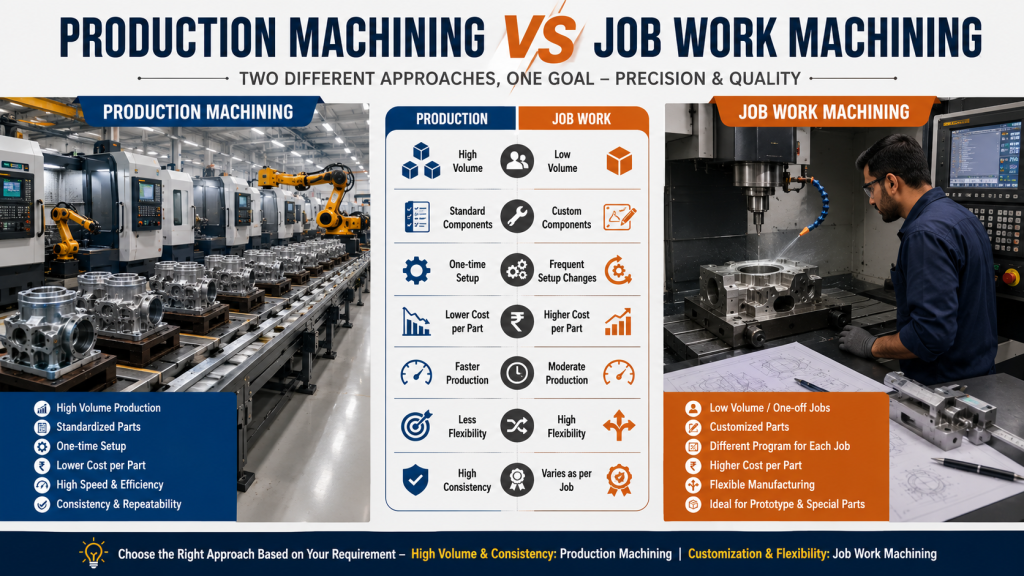
Production Machining vs Job Work Machining
| Feature | Production Machining | Job Work Machining |
|---|---|---|
| Production Volume | Large quantity | Small quantity |
| Product Type | Standard components | Custom components |
| Machine Setup | One-time setup | Frequent setup changes |
| CNC Program | Repeated program | Different program for each job |
| Production Cost | Lower per part | Higher per part |
| Manufacturing Speed | Very fast | Moderate |
| Flexibility | Low | High |
| Customer Requirement | Same design | Customized design |
Advantages of Production Machining
Production machining offers many benefits for industries that manufacture products in large quantities.
Key Advantages
1. High Productivity
Production machining allows manufacturers to produce thousands of identical parts in a short time.
2. Lower Manufacturing Cost
Since the setup is completed only once, the cost per component decreases significantly.
3. Better Quality Consistency
Every component follows the same machining process. Therefore, dimensional accuracy remains consistent.
4. Efficient Automation
Manufacturers can integrate robots, pallet changers, and automatic tool changers into production machining.
5. Faster Delivery
Large batches can be completed quickly because the machining process is optimized.
Advantages of Job Work Machining
Job work machining is suitable for companies that require flexibility and customized manufacturing.
Key Advantages
1. Custom Manufacturing
Customers receive products according to their exact specifications.
2. Flexible Production
Manufacturers can produce different components without investing in dedicated production lines.
3. Ideal for Prototypes
Engineers often use job work machining to manufacture prototype parts before mass production.
4. Supports Multiple Industries
Job work machining serves industries such as automotive, aerospace, medical equipment, and industrial machinery.
5. Handles Complex Components
It is suitable for one-off or highly specialized parts that require unique machining operations.
When Should You Choose Production Machining?
Production machining is the best option when:
- Large quantities are required.
- Product design remains unchanged.
- Fast production is important.
- Manufacturing costs must be reduced.
- Consistent quality is required.
When Should You Choose Job Work Machining?
Job work machining is suitable when:
- Products are customized.
- Production quantity is low.
- Prototype development is required.
- Design changes occur frequently.
- Customers require special components.
Industries That Use Production Machining
Many industries depend on production machining for mass manufacturing.
Common Industries
- Automotive Manufacturing
- Consumer Electronics
- Home Appliances
- Industrial Equipment
- Bearing Manufacturing
- Fastener Manufacturing
Industries That Use Job Work Machining
Job work machining supports industries that require custom manufacturing.
Common Industries
- Tool and Die Manufacturing
- Aerospace Components
- Medical Equipment
- Research and Development
- Industrial Maintenance
- Prototype Manufacturing
Skills Required for Both Machining Methods
Whether you work in production machining or job work machining, the following skills are valuable:
- CNC Machine Operation
- CNC Programming
- CAM Software
- Engineering Drawing Reading
- Tool Selection
- Quality Inspection
- Machine Setup
- Measuring Instruments
Career Opportunities
Professionals with CNC machining knowledge can build successful careers in both manufacturing sectors.
Popular Job Roles
- CNC Operator
- CNC Programmer
- VMC Programmer
- CAM Programmer
- Production Engineer
- Quality Engineer
- Manufacturing Engineer
- Process Engineer
Conclusion
Production machining and job work machining play important roles in modern manufacturing. Production machining focuses on high-volume manufacturing with consistent quality and lower costs. In contrast, job work machining emphasizes flexibility, customization, and small-batch production.
Therefore, choosing the right machining method depends on production quantity, customer requirements, and manufacturing goals. Students who understand both methods will be better prepared for careers in CNC machining and manufacturing.