Computer-Aided Design (CAD) has become an essential part of modern product development. Engineers and designers use CAD software to create accurate 2D drawings and realistic 3D models. Therefore, CAD helps companies design products faster, reduce errors, and improve product quality.
Today, industries such as automotive, aerospace, medical, and consumer electronics rely on CAD software to develop innovative products. As a result, learning CAD has become an important skill for mechanical engineering students and manufacturing professionals.
What is CAD?
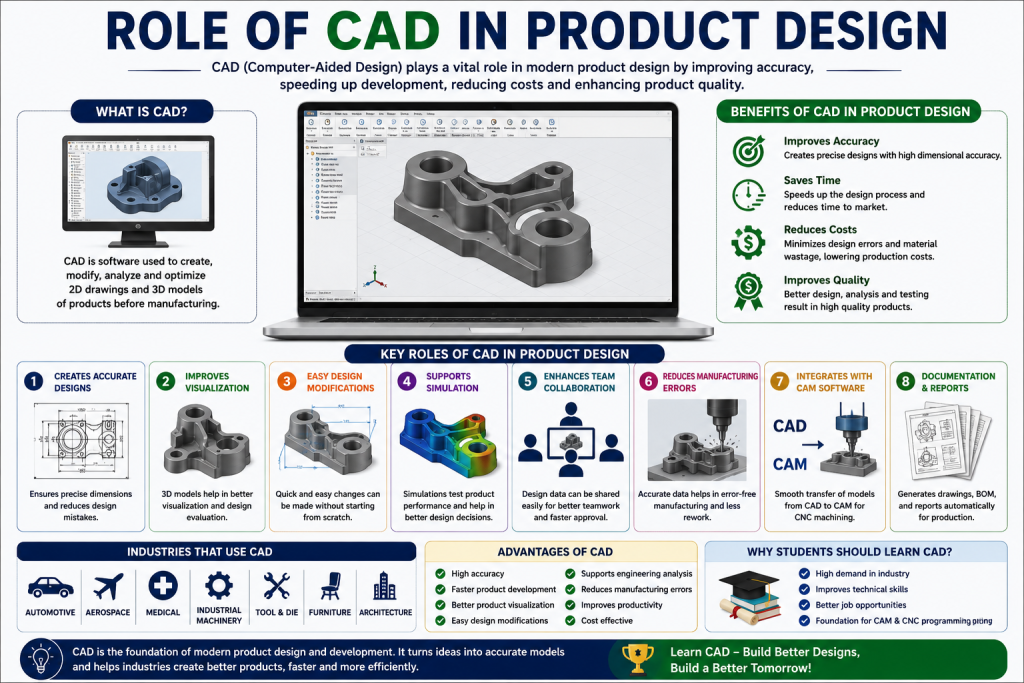
CAD stands for Computer-Aided Design. It is software used to create, modify, analyze, and optimize product designs. Unlike traditional manual drafting, CAD allows designers to make quick changes and visualize products before manufacturing begins.
Moreover, CAD software supports both 2D drafting and 3D modeling, making the design process more efficient.
Why is CAD Important in Product Design?
CAD allows designers to create detailed product models before production starts. Consequently, manufacturers can identify design issues early and avoid expensive mistakes.
Furthermore, CAD improves collaboration between designers, engineers, and manufacturers by providing accurate digital models.
Role of CAD in Product Design
1. Creates Accurate Product Designs
CAD software helps designers create highly accurate drawings and 3D models. Therefore, every product meets the required dimensions and specifications.
Benefits
- High design accuracy
- Better dimensional control
- Fewer design mistakes
2. Speeds Up the Design Process
Traditional drafting requires significant time. However, CAD software allows quick modifications and automatic updates.
As a result, companies complete product designs much faster.
Benefits
- Faster product development
- Reduced design time
- Improved productivity
3. Improves Product Visualization
CAD creates realistic 3D models before manufacturing begins.
Therefore, designers and customers can visualize the final product clearly.
Benefits
- Better product presentation
- Easy design review
- Improved customer approval
4. Simplifies Design Modifications
Product requirements often change during development. Fortunately, CAD allows designers to edit models without creating new drawings.
Consequently, design revisions become simple and efficient.
Benefits
- Easy modifications
- Faster updates
- Lower design costs
5. Supports Product Simulation
Many CAD programs include simulation tools that test product performance before manufacturing.
As a result, engineers can identify weak areas and improve the design.
Benefits
- Early problem detection
- Improved product performance
- Reduced testing costs
6. Enhances Team Collaboration
CAD files can be shared easily among design, production, and quality teams.
Moreover, everyone works with the same design data, reducing communication errors.
Benefits
- Better teamwork
- Faster decision-making
- Improved project management
7. Reduces Manufacturing Errors
Accurate CAD models provide precise dimensions for manufacturing.
Therefore, CNC programmers and production engineers receive reliable design data.
Benefits
- Reduced production errors
- Better machining accuracy
- Less material waste
8. Integrates with CAM Software
Modern CAD software works directly with CAM software.
As a result, CAD models can generate CNC toolpaths automatically without redrawing the part.
Benefits
- Smooth CAD/CAM workflow
- Faster CNC programming
- Higher production efficiency
Industries That Use CAD in Product Design
CAD plays an important role in many industries.
Common Applications
- Automotive Industry
- Aerospace Industry
- Medical Equipment Manufacturing
- Consumer Electronics
- Industrial Machinery
- Tool and Die Manufacturing
- Furniture Design
- Architecture and Construction
Advantages of CAD in Product Design
- Improves design accuracy
- Reduces development time
- Creates realistic 3D models
- Simplifies design changes
- Supports engineering analysis
- Reduces manufacturing costs
- Improves product quality
- Increases productivity
Why Mechanical Students Should Learn CAD
Mechanical engineering students should learn CAD because industries require skilled designers.
Moreover, CAD knowledge improves technical skills and increases job opportunities.
Students who understand CAD can also learn CAM software and CNC programming more easily.
Future Scope of CAD in Product Design
The future of CAD continues to grow with technologies such as Artificial Intelligence (AI), cloud computing, digital twins, and Industry 4.0.
Therefore, companies will continue to demand professionals with advanced CAD skills.
Learning CAD today prepares students for successful careers in modern manufacturing and product development.
Conclusion
CAD has transformed the way products are designed and developed. It improves accuracy, speeds up product development, and reduces manufacturing errors. Moreover, CAD integrates with CAM software to support efficient CNC machining.
Therefore, learning CAD is essential for students, designers, and engineers who want to build a successful career in product design and manufacturing.