Introduction
Tool offsets and wear offsets are essential concepts in CNC machining that ensure accurate dimensions and safe machining. Without proper tool offsets, CNC machines cannot understand the exact position and length of the cutting tool.
For CNC operators and programmers, learning tool offsets and wear offsets is a must to avoid tool crashes and machining errors.
What is Tool Offset in CNC?
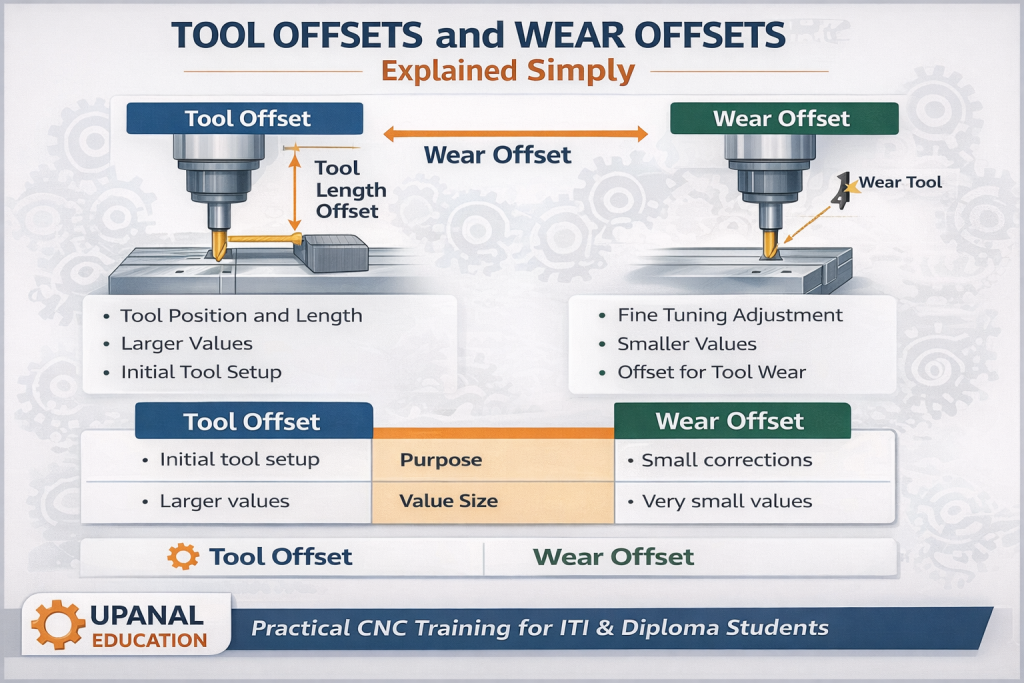
A tool offset tells the CNC machine the exact position and length of the cutting tool relative to the machine reference point.
In simple words:
👉 Tool offset = Tool position data stored in the machine.
Every cutting tool has:
- Different length
- Different diameter
- Different position
Why Tool Offsets Are Important
Tool offsets help to:
- Maintain machining accuracy
- Avoid tool crash
- Reduce setup time
- Improve repeat production
- Increase productivity
Without tool offsets, every program would need manual adjustments.
Types of Tool Offsets
1️⃣ Tool Length Offset
Tool length offset measures the length of the tool from spindle to tool tip.
Used in:
- CNC Milling (VMC)
- Drilling operations
Example:
Different drills have different lengths. The machine uses tool length offset to know the correct Z position.
2️⃣ Tool Diameter Offset (Cutter Compensation)
Tool diameter offset tells the machine the radius/diameter of the cutting tool.
Used in:
- Profile machining
- Pocket machining
- Contour cutting
Common G Codes:
- G41 – Cutter compensation left
- G42 – Cutter compensation right
What is Wear Offset?
Wear offset is a small adjustment made to compensate for tool wear during machining.
Over time, tools become:
- Worn out
- Slightly shorter
- Slightly smaller in diameter
Instead of changing the full tool offset, we use wear offset to make small corrections.
👉 Wear offset = Fine tuning adjustment.
Why Wear Offset is Used in Industry
Wear offsets help to:
- Maintain part accuracy in production
- Reduce machine downtime
- Increase tool life
- Avoid reprogramming
In mass production, wear offset is used daily.
Difference Between Tool Offset and Wear Offset
| Feature | Tool Offset | Wear Offset |
|---|---|---|
| Purpose | Initial tool setup | Small corrections |
| Value size | Larger values | Very small values |
| Used when | New tool setup | Tool gets worn |
| Frequency | Once per setup | During production |
Tool Offsets in CNC Turning vs Milling
CNC Turning
- Tool offsets include X and Z values
- Each tool has its own offset number (T01, T02…)
CNC Milling (VMC)
- Tool length offset (H values)
- Cutter compensation (D values)
Common Mistakes Students Make
- Entering wrong tool offset number
- Forgetting to update wear offset
- Using wrong H or D value
- Skipping trial run
- Not checking tool length properly
Tool Offset Training at Upanal Education
At Upanal Education, students learn:
- Practical tool offset setting on CNC Turning & VMC
- Real-time tool measurement methods
- Industrial production practices
- Error-free programming techniques
Our training focuses on hands-on learning and job readiness.
Conclusion
Understanding tool offsets and wear offsets is essential for accurate CNC machining and production work. Mastering this concept helps students become confident CNC operators and programmers.